


The Importance of Environmentally Friendly Offices
The development of environmentally-friendly offices has been a consistent focus in Singapore for the past decade, largely due to the government’s push for greater sustainability in the built environment.
Office buildings in Singapore are now expected to perform in terms of sustainability, according to the Building and Construction Authority’s Green Mark Certification Scheme, launched in 2005.
For businesses, the importance of environmentally friendly office spaces and the relevant benefits are now a key consideration in office selection.
THE RISE OF SUSTAINABLE OFFICE BUILDINGS IN SINGAPORE
Singapore’s green building movement has come a long way. Back in 2005, just 17 buildings carried a Green Mark certification. Today in 2026, that number stands at 4,807[1].
Much of this growth traces back to the Green Building Masterplan, which sets out three headline targets for 2030: 80% of buildings by gross floor area to be Green Mark-certified, 80% of new developments to hit Super Low Energy ratings, and an 80% improvement in energy efficiency against the 2005 baseline.
There is a clear shift from environmentally friendly features being “a nice-to-have” to a new standard for Singapore office buildings. For businesses, that raises an important question: what does choosing a greener office actually mean in practice?
 Artist’s Impression
HOW DOES AN ENVIRONMENTALLY-FRIENDLY
OFFICE BENEFIT TENANTS?
An environmentally friendly office is built to reduce carbon emissions while enhancing the quality of the working environment.
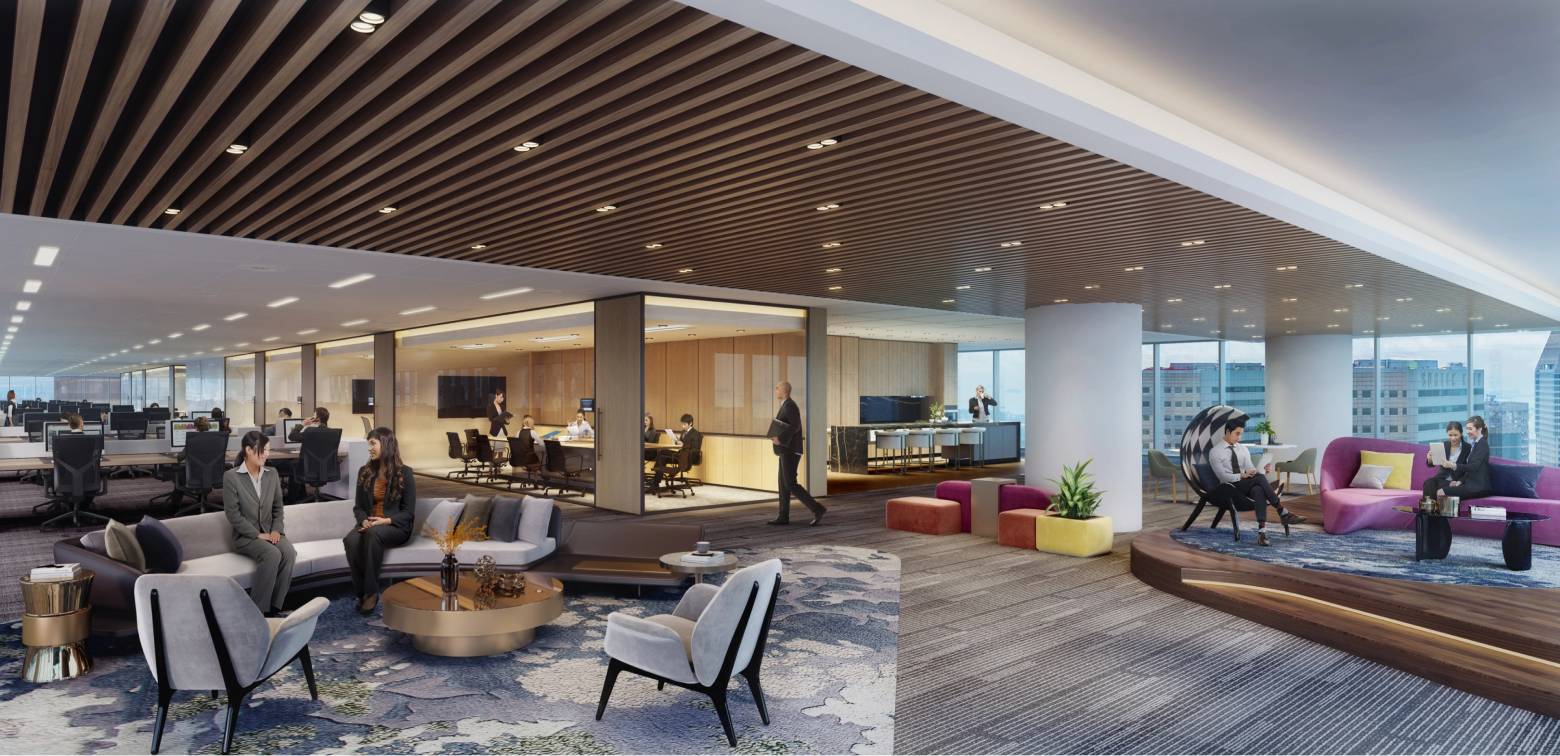
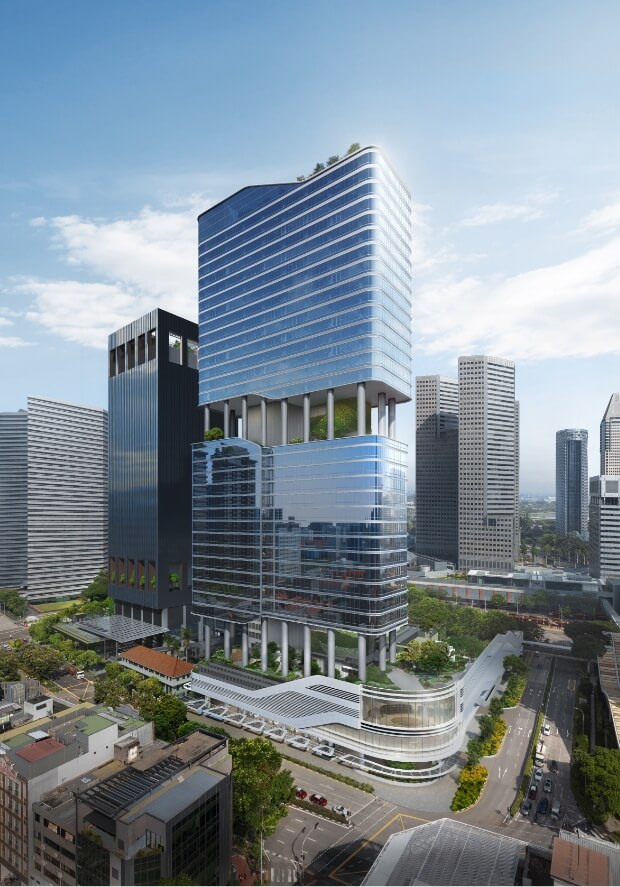
Shaw Tower is an exemplary example of a Grade A office building with environmentally-friendly workspaces for tenants. Located in the Ophir-Rochor Corridor of Singapore’s CBD, Shaw Tower is the first Grade A office building in Singapore to achieve Green Mark Platinum (Super Low Energy) certification under the new 2021 requirements, and the first building in Singapore and Asia to hold both SmartScore Platinum and WiredScore Platinum certifications.
While these sustainability ratings are impressive in their own right, they also have a tangible impact on businesses that set up office in the building.
 Artist’s Impression
Eco-friendly offices cost less to run, and the savings are more significant than many businesses expect. Green Mark Platinum (Super Low Energy) buildings, like Shaw Tower, typically achieve 30-40% energy savings compared to uncertified buildings[2]. For a 20,000 sq ft office – this comes up to savings estimates at $100,000 in electricity costs each year.
Shaw Tower’s hybrid air conditioning, smart lighting, and low-E high-performance glazing all work together to cut the energy required to keep the building running comfortably. Shaw Tower also generates its own clean energy onsite through rooftop solar PV panels and a wind turbine, further offsetting day-to-day power costs.

With employees staying indoors for at least 8 hours each work day, poor air quality in the workplace can worsen environmental conditions in the office. Stale air, airborne viruses, and pollutants can cause workers to fall ill more frequently, leading to lapses in employee attendance.
The indoor air quality monitoring system at Shaw Tower uses MERV 14 and UVGI (Ultraviolet Germicidal Irradiation) filters to prevent airborne germs and pollutants from lingering in the office environment.

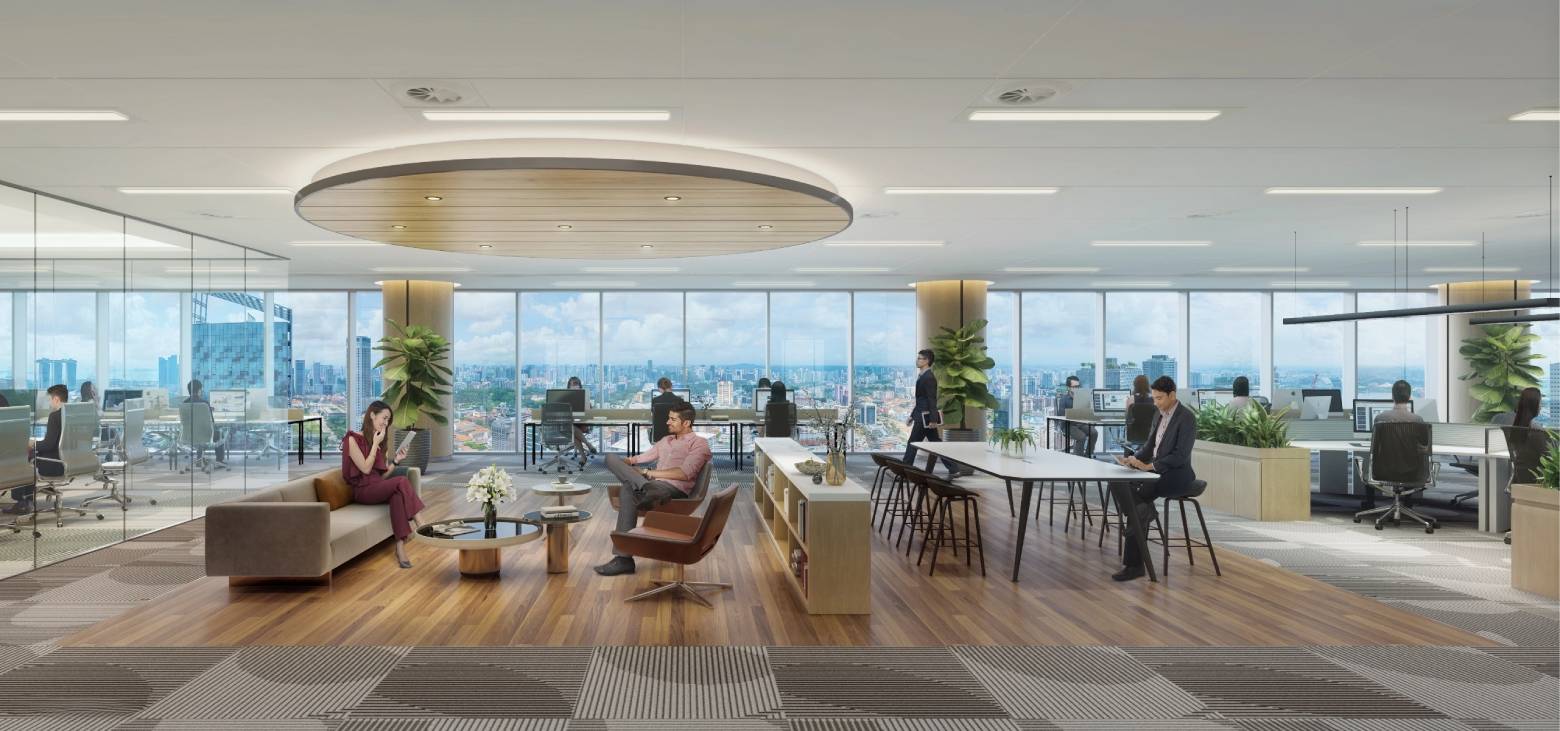
The quality of a workspace has a direct impact on employee workplace performance. A 2016 study found that employees in high outdoor air-ventilation offices scored 101% higher than workers in conventional spaces on cognitive performance tests.[3]
Biophilic design, another aspect commonly found in eco-friendly offices, also has a positive impact on productivity. According to a report by Humans Spaces back in 2015, office workers are 6% more productive when surrounded by greenery and sunlight.[4]
Shaw Tower’s green plot ratio of 5.4, higher than the 4.5 average for HDB units, means tenants have genuine access to natural greenery through sky terraces and landscaped decks, not just a potted plant in the lobby.

A business’s choice of office reflects its values and identity. Aside from a prestigious location in the CBD, environmentally-friendly features in the office are also looked at favourably by workers, especially those in younger cohorts.
According to a 2024 survey by Deloitte, more than half of Gen Z workers (54%) and nearly half of millennials (48%) are urging their company to take more action on environmentally-friendly measures.[5]
Operating in a green building is a simple way to demonstrate, not just declare, that sustainability is a real priority for the business. Shaw Tower’s credentials as the first Grade A building in Singapore to achieve Green Mark Platinum (SLE) under the new 2021 requirements make it a prime choice for businesses that want to showcase their commitment to sustainability.

For businesses with ESG obligations, an environmentally-friendly office can take a lot of the heavy lifting out of compliance.
Shaw Tower’s IoT-based air quality monitoring system tracks and records environmental data in real time, providing the kind of documented, verifiable information that ESG reporting demands.
As sustainability standards continue to tighten locally and internationally, having such infrastructure built into the workspace is a way to future-proof the business’s current operations.
- Green Mark Buildings | BCA. (n.d.). data.gov.sg. https://data.gov.sg/datasets/d_c4bd082b48fa7611713f39e23d250c27/view
- Smyth, K. (2025, October 21). Complete Guide to Green Mark certification for office spaces in Singapore | Facilitate Corporation |. Facilitate Corporation. https://www.facilitatecorp.com/complete-guide-to-green-mark-certification-for-office-spaces-in-singapore/
- Allen, J. G., MacNaughton, P., Satish, U., Santanam, S., Vallarino, J., & Spengler, J. D. (2015). Associations of Cognitive Function Scores with Carbon Dioxide, Ventilation, and Volatile Organic Compound Exposures in Office Workers: A Controlled Exposure Study of Green and Conventional Office Environments. Environmental Health Perspectives, 124(6), 805–812. https://pubmed.ncbi.nlm.nih.gov/26502459
- Interface. (2015). Human spaces: The global impact of biophilic design in the workplace. https://www.interface.com/content/dam/interfaceinc/interface/global-campaigns/human-spaces/report/global-human-spaces-report/Human%20Spaces%20report%202015%20EN.pdf
- Deloitte’s 2024 Gen Z and Millennial Survey | Deloitte Global. (2024, May 15). Deloitte. https://www.deloitte.com/global/en/about/press-room/deloitte-2024-gen-z-and-millennial-survey.html