



Singapore Green Plan 2030 – New Office Building Standards
Launched in 2021, Singapore’s Green Plan 2030 is a national sustainability strategy created to support the country’s sustainable development agenda. It is part of Singapore’s aim to achieve net-zero emissions by 2050. The new office building standards continue to raise the bar for environmentally friendly urban growth, supporting the nation’s drive to be a leading hub for green finance, carbon trading, and sustainable tourism.
AN OVERVIEW OF
THE SINGAPORE GREEN PLAN 2030
Singapore’s Green Plan 2030 enforces strict, mandatory environmental sustainability requirements for new office buildings through the Building and Construction Authority (BCA) Green Mark scheme. Developers are now required to meet stringent green certifications, with the “80-80-80” Goal by 2030 being enforced across existing and new developments.
The ambitious “80-80-80” Goal by 2030 refers to the following:

At least 80% of Singapore’s buildings (by Gross Floor Area) achieve certified green standards.
80% of new developments need to achieve Super Low Energy (SLE) standards. This means they must achieve significant energy savings over 2005 building codes, deploy renewable energy, and utilise intelligent energy management systems.
80% improvement in energy efficiency (compared to 2005 levels) for best-in-class green buildings by 2030.



WHY OFFICE BUILDINGS ARE A KEY FOCUS
The building sector accounts for over 20% of Singapore’s carbon emissions, so office buildings have been made a primary focus of the Singapore Green Plan 2030. It has been identified that upgrading commercial real estate is essential for reducing the national carbon footprint, meeting international climate commitments, and keeping Singapore’s economy globally competitive.
Through the Singapore Green Building Masterplan (SGBMP), the Building and Construction Authority (BCA) requires stringent environmental standards. Existing legislation mandates that commercial buildings must achieve minimum Green Mark certification levels and undergo compulsory energy audits.
Commercial buildings are also very energy-intensive, largely due to air conditioning. Upgrading to energy-efficient systems and constructing more thermally efficient buildings are the most effective way to significantly reduce these operational emissions.
There are also key financial benefits for building owners and developers. For example, multinational corporations have their own strict environmental mandates. Green-certified offices command higher rental premiums and maintain stronger occupancy rates, making sustainability highly profitable for landlords. For Singapore as a nation, transforming commercial real estate reinforces the country’s goal to become a leading green finance and technology hub in Asia, which creates jobs and drives new investments.
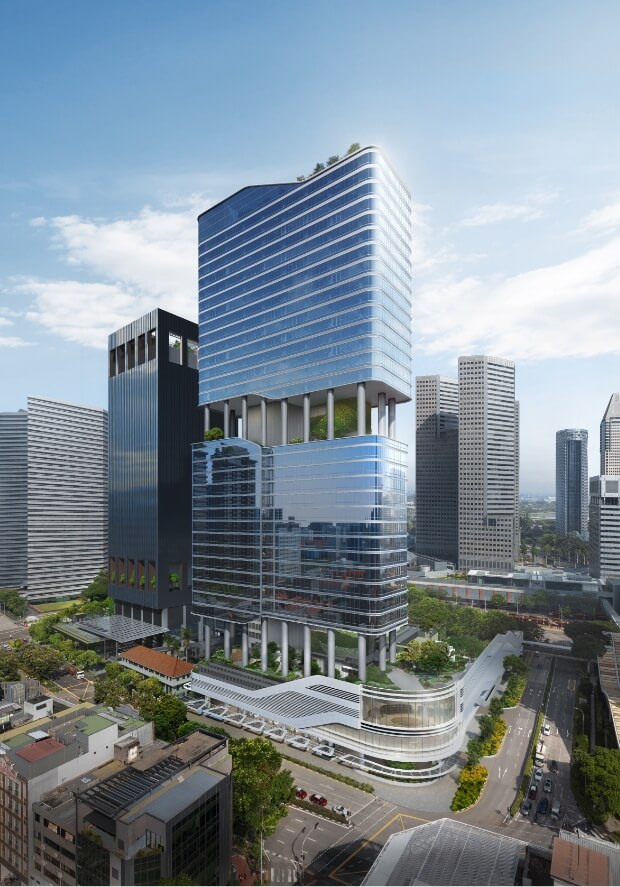 Artist’s Impression
NEW STANDARDS FOR OFFICE BUILDINGS UNDER THE GREEN PLAN
The new standards for office buildings are driven by the Singapore Green Building Masterplan (SGBMP), which targets the “80-80-80” goals by 2030. The baseline for Grade A office spaces has shifted, making the Building and Construction Authority’s (BCA) Green Mark certification an industry requirement rather than a premium differentiator.

The Green Mark scheme has been administered by the BCA since 2005 and is tailored to Singapore’s tropical climate. The latest iteration, Green Mark 2021 (GM:2021), launched in September 2021, requires much higher environmental performance and is performance-based, with energy efficiency as the mandatory prerequisite. New buildings have to be at least 50% more energy-efficient than 2005 levels and must achieve strict energy audits. Building owners must complete mandatory annual submissions, including energy audits of building cooling systems.
Certification is tiered across Certified, Gold, GoldPLUS, and Platinum, alongside Super Low Energy (SLE), Zero Energy (ZE), and Positive Energy (PE) recognitions. While older standards only mandated basic certification, the market standard now heavily favours Green Mark Gold or Platinum as large multinational tenants require high sustainability credentials for their ESG portfolios. Adding to this, SGX Listing Rules mandate emissions disclosures for large, listed corporations, meaning the energy data gathered for Green Mark compliance is directly used to calculate corporate Scope 1 and Scope 2 carbon emissions.
Shaw Tower is one example of a building that has achieved Super Low Energy (SLE) certification under this scheme, reflecting the kind of performance now expected of Grade A commercial developments.

For existing buildings, the Mandatory Energy Improvement (MEI) regime requires commercial buildings whose energy use intensity that is below a defined threshold to conduct energy audits and propose improvement works. The MEI first took effect in Q3 2025.
For businesses with offices in buildings captured by the MEI, this could result in disruptive construction works to bring the building in line with improved energy standards.

In November 2025, the BCA and the Singapore Green Building Council introduced the new Green Mark for Interiors (GMI) scheme, which covers certification for a business’s office fit-out. While not mandatory, GMI certification remains an important consideration for tenanted fit-outs, as many Grade A buildings require compliance with Green Mark principles through lease agreements or building management guidelines.
Shaw Tower’s flexible layouts, large floor plates, and knockout panels are an example of how a building can give tenants greater opportunity to design an energy-efficient office fit-out in line with GMI principles.

The Building and Construction Authority (BCA) enforces compliance primarily through the BCA Green Mark Certification scheme, with progressively stricter thresholds. The plan sets major milestones for the built environment, including that by 2030, 80% of new developments (by GFA) must meet the Super Low Energy standard, effectively becoming the new baseline for construction. Also, authorities are progressively requiring building owners to publicly disclose energy performance data and establish “Building Passports” to trace whole-life carbon and material lifecycles.
All new government buildings and major refurbishments are mandated to achieve Green Mark GoldPLUS or higher. Whereas the following must achieve a minimum of Green Mark Certified:
- New Private Developments with a GFA of 2,000 sqm or more.
- New Commercial, Retail or Institutional Developments with a GFA of 5,000 sqm or more.
- Buildings undergoing major retrofits (with 50% or more of mechanical and electrical works).
WHAT THIS MEANS FOR
BUILDING OWNERS AND BUSINESSES
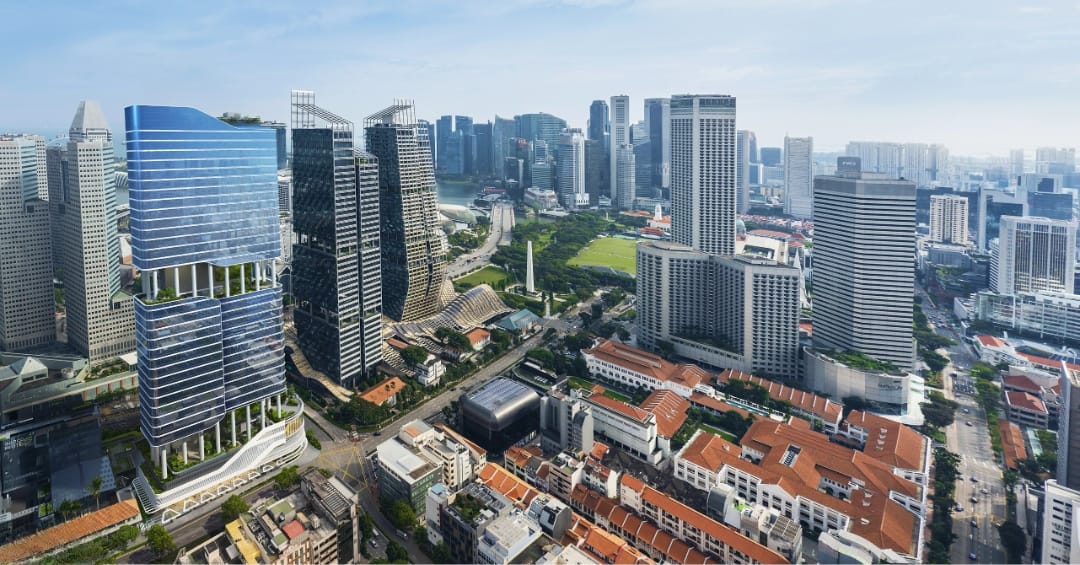 Artist’s Impression
What This Means for Businesses:
Singapore’s carbon tax is set to rise steeply from S$5/tonne CO2 (2023) to S$50–80/tonne by 2030. For commercial building owners and operators, this increase is likely to translate into a higher operating penalty for poor energy efficiency, and this added cost is likely to be passed down to tenants in the form of higher rents — incentivising business tenants to choose buildings that already have green upgrades in place. Businesses and tenants operating in non-certified buildings may also face rising rental costs or “brown discount” penalties as landlords pass down the costs of green upgrades and carbon taxes.
As the building sector shifts towards whole-life carbon tracking, businesses within the real estate supply chain (manufacturers, contractors) will face demands for comprehensive Environmental Product Declarations (EPDs).
Occupying a BCA Green Mark-certified building with optimal indoor air quality and low-carbon emissions aligns with corporate ESG goals and directly aids in attracting top-tier talent.
Sustainable office buildings also deliver lower operating costs through higher energy efficiency, which aids businesses with corporate ESG and carbon reporting obligations – particularly MNCs that require more oversight of international offices. Shaw Tower, for example, combines high energy efficiency with smart building technology and data-driven systems that let tenants view the energy sources used for heating, cooling, and power, supporting consistent sustainability reporting.
What This Means for Building Owners:
Failure to conduct mandatory audits or meet the minimum energy performance thresholds for existing buildings and major retrofits can lead to regulatory penalties.
Assets that fail to achieve updated BCA Green Mark certifications risk obsolescence. Tenants are increasingly demanding eco-certified spaces to meet their own Environmental, Social and Governance (ESG) standards.
Building owners must budget for retrofits, such as shifting to energy-efficient smart HVAC systems, LED upgrades, and integrating on-site solar, to avoid the Mandatory Energy Improvement (MEI) regime penalties.
Final Thoughts
The Singapore Green Plan 2030 presents an opportunity for owners of existing commercial buildings and those currently building new commercial spaces to be world leaders in sustainable development. Compliance with the new Green Mark Scheme standards is necessary to avoid penalties, but also presents significant financial benefits.