



What Makes A ‘Sustainable Building’ in Singapore?
Singapore is globally renowned for its focus on sustainability in national development. Since the 1960s, sustainable building practices and policies have ensured a careful balance between natural and urban environments across the country.
The Singapore Green Plan 2030 is the newest initiative of the country’s efforts to promote sustainable development. The Green Plan aims to align new commercial developments with the sustainability objectives of the Singapore Government. Further, it seeks to incentivise the designs of green buildings offering better energy efficiency and lower long-term operational costs.
As demand for sustainable office spaces in Singapore increases, businesses need to understand what makes a sustainable building and the benefits of environmentally-friendly offices.
WHAT ARE THE ELEMENTS OF
A SUSTAINABLE BUILDING?
Buildings in Singapore are rated for sustainability based on the Building and Construction Authority’s (BCA) Green Mark certification scheme. The BCA assesses the building’s energy efficiency, sustainable design and construction, and renewable energy integration. There are four levels of certification: Green Mark Certified, Green Mark Gold, Green Mark GoldPLUS, and Green Mark Platinum.
To achieve the Super Low Energy rating under the highest Green Mark Platinum certification, buildings must achieve at least 60% energy savings above the 2005 building code requirements for standard buildings.
According to Singapore’s Green Building Masterplan, 80% of new developments by gross floor area (GFA) are expected to achieve the BCA’s Green Mark Platinum (Super Low Energy) certification from 2030 onwards.
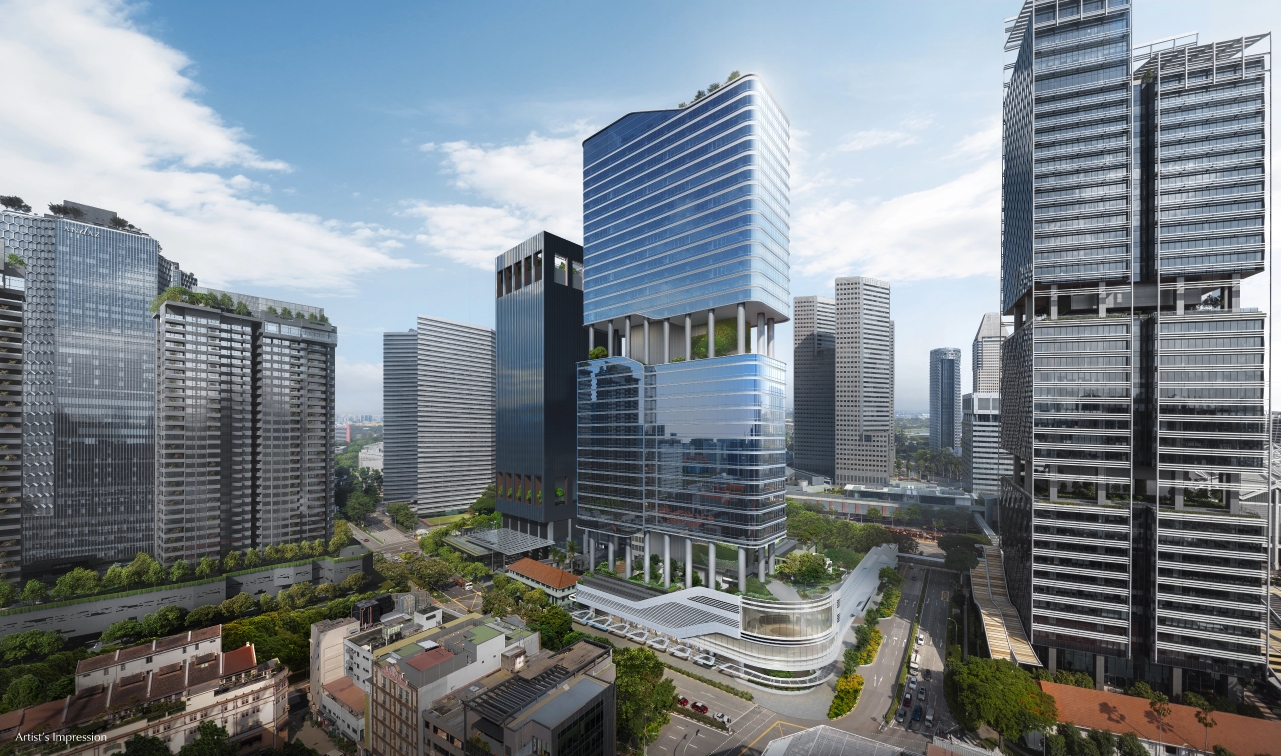
Under the latest 2021 criteria, Shaw Tower is the first Grade A commercial building in Singapore to have been awarded the BCA’s Green Mark Platinum (Super Low Energy) certification. This makes Shaw Tower a perfect example to illustrate what a sustainable building in Singapore looks like.

ENERGY EFFICIENCY AND SAVINGS
Lower energy requirements for a building mean less harmful carbon emissions. Air conditioning, lighting, and power supply all contribute to the building’s energy consumption, of which are kept as efficient as practically possible in Shaw Tower’s design, with consideration for safety and basic needs.
With buildings (construction and operation) accounting for about 20% of national carbon emissions[1], the goal of sustainable buildings is to reduce energy consumption.
Shaw Tower is expected to deliver over 60% in energy savings compared to standard office buildings, drastically reducing its carbon footprint and contributing to national sustainability goals.
Shaw Tower leverages smart technology for lighting, automated air filtration, and a hybrid airconditioning system throughout the building’s infrastructure to keep energy consumption low and minimise waste.
For tenants, the energy savings achieved by sustainable buildings like Shaw Tower directly carry over in the form of lower operational costs in the long-term.

SUSTAINABLE COMMERCIAL CONSTRUCTION
Measuring sustainability also includes the energy and materials used during the construction of the building.
Carbon emissions from the extraction, manufacturing, and transportation of building materials used in construction are referred to as embodied carbon, which accounts for 11% of global carbon emissions.[2]
To minimise its embodied carbon, Shaw Tower uses sustainable building practices such as biodiesel and AMPD electricity for crane operations, 4-tick concrete as Singapore Green Building Council (SGBC) rating, and the incorporation of SGBC-certified sustainable products.

RENEWABLE ENERGY INTEGRATION
Sustainable buildings make use of renewable energy sources to reduce dependence on conventional carbon-based power generation.
Renewable energy generators, such as rooftop solar panels and a wind turbine, have been installed in Shaw Tower to offset operational energy consumption and improve energy efficiency.

BUILDING
DESIGN AND FEATURES
Beyond operational metrics such as energy efficiency, how sustainable a building is can also be assessed by how its design and features encourage sustainable practices.
In the case of Shaw Tower, the building is equipped with end-of-trip facilities that encourage green commuting such as cycling or public transport. Shaw Tower also provides sheltered connectivity to nearby bus stops and 4 MRT stations for easy access.
Providing essential facilities like lockers, showers, and secure bicycle parking spaces makes commuting/ exercising easier for tenants, allowing them to embrace sustainability in Singapore.

FOCUS ON
HEALTH AND WELLNESS
Sustainable buildings also have ample green spaces that improve the air quality and also provide tenants with a fresh and calming ambience.
This type of building design is referred to as biophilic design, which incorporates elements from the natural environment.
Biophilic design can positively contribute to sustainable architecture. A critical review published in Frontiers of Architectural Research claims that biophilic design was reported to have an impact on climate change mitigation, improved indoor air quality, and enhancement of physical and mental health in 2021.[3]
Shaw Tower features a biophilic design with a green plot ratio of 5.4, which exceeds the minimum 4.5 green plot ratio required for HDB communities. For tenants, this means a greener, more comfortable, and healthier work environment.